BESS Delay in Startup Insurance: Commissioning Delays, Revenue Loss, Deductibles, and Claim Triggers
See How We're Different
Or Call Us: (281) 823-8262

A single battery energy storage system can represent $200 million or more in capital investment, and a six-month commissioning delay doesn't just push back your revenue timeline: it can trigger loan covenant defaults, penalty clauses in offtake agreements, and millions in lost arbitrage income. Delay in startup insurance for BESS projects exists precisely to absorb these financial shocks, yet it remains one of the most misunderstood coverages in the energy storage sector.
The
BESS insurance market has
grown to a valuation of $4.8 billion and is projected to reach $14 billion within the next several years. That growth reflects both the rapid buildout of storage capacity and the hard lessons learned from projects that stalled during commissioning. Whether the cause is a damaged transformer, a permitting delay, or a failed battery module during site testing, DSU coverage bridges the gap between
physical damage and financial survival. Understanding how commissioning delays, revenue loss, deductibles, and claim triggers interact is essential for any
project sponsor, lender, or developer putting capital at risk.
Understanding DSU Insurance for BESS Projects
DSU insurance is a time-element coverage that responds when a covered physical loss or damage event delays the commercial operation date (COD) of a project. It doesn't cover the cost of repairing or replacing damaged equipment: that's the job of your construction all-risks (CAR) or marine cargo policy. Instead, DSU picks up the financial consequences of the delay itself, including lost revenue, continuing fixed costs, and increased financing expenses.
For BESS projects, the financial exposure during a delay is particularly acute. Battery storage earns revenue through multiple streams: energy arbitrage, frequency regulation, capacity payments, and ancillary services. Every day past the planned COD is a day those revenue streams sit at zero while debt service obligations, land lease payments, and staff costs continue to accumulate.
The Role of Delay in Startup (DSU) in Energy Storage
DSU coverage for energy storage differs from traditional power generation in a few critical ways. BESS projects often have tighter commissioning windows because offtake contracts and capacity market obligations are tied to specific delivery dates. Missing a PJM or CAISO capacity auction commitment, for example, can result in penalties that dwarf the cost of the physical damage that caused the delay.
The policy's indemnity period, which is the maximum duration it will pay out, must be carefully calibrated to the project's specific risk profile. A 100 MW/400 MWh lithium-ion facility with a 14-month construction timeline needs a different indemnity structure than a 20 MW flow battery pilot. Your broker should model worst-case delay scenarios, including long-lead equipment replacement times, to set appropriate limits.
How DSU Integrates with Marine Cargo and ALOP
DSU for BESS projects frequently attaches to two underlying policies: the CAR policy covering on-site construction risks, and the marine cargo policy covering equipment in transit. The marine-linked version is often called Advance Loss of Profits (ALOP) or Delay in Start-Up following Marine Transit.
Here's why this matters: if a shipment of
battery modules suffers water damage during ocean transit and requires a 90-day replacement cycle, ALOP responds to the financial loss during that delay. The CAR-linked DSU, by contrast, covers delays caused by events on-site, like a fire during commissioning testing. Many projects need both, and the policies must be coordinated so there are no gaps or overlapping deductibles.
Common Triggers for Commissioning Delays
Not every delay triggers a DSU claim. The policy responds only to delays caused by physical loss or damage covered under the underlying CAR or marine policy. Pure financial delays, labor disputes without physical damage, or regulatory hold-ups generally fall outside DSU coverage unless specifically endorsed.
Supply Chain Disruptions and Transit Damage
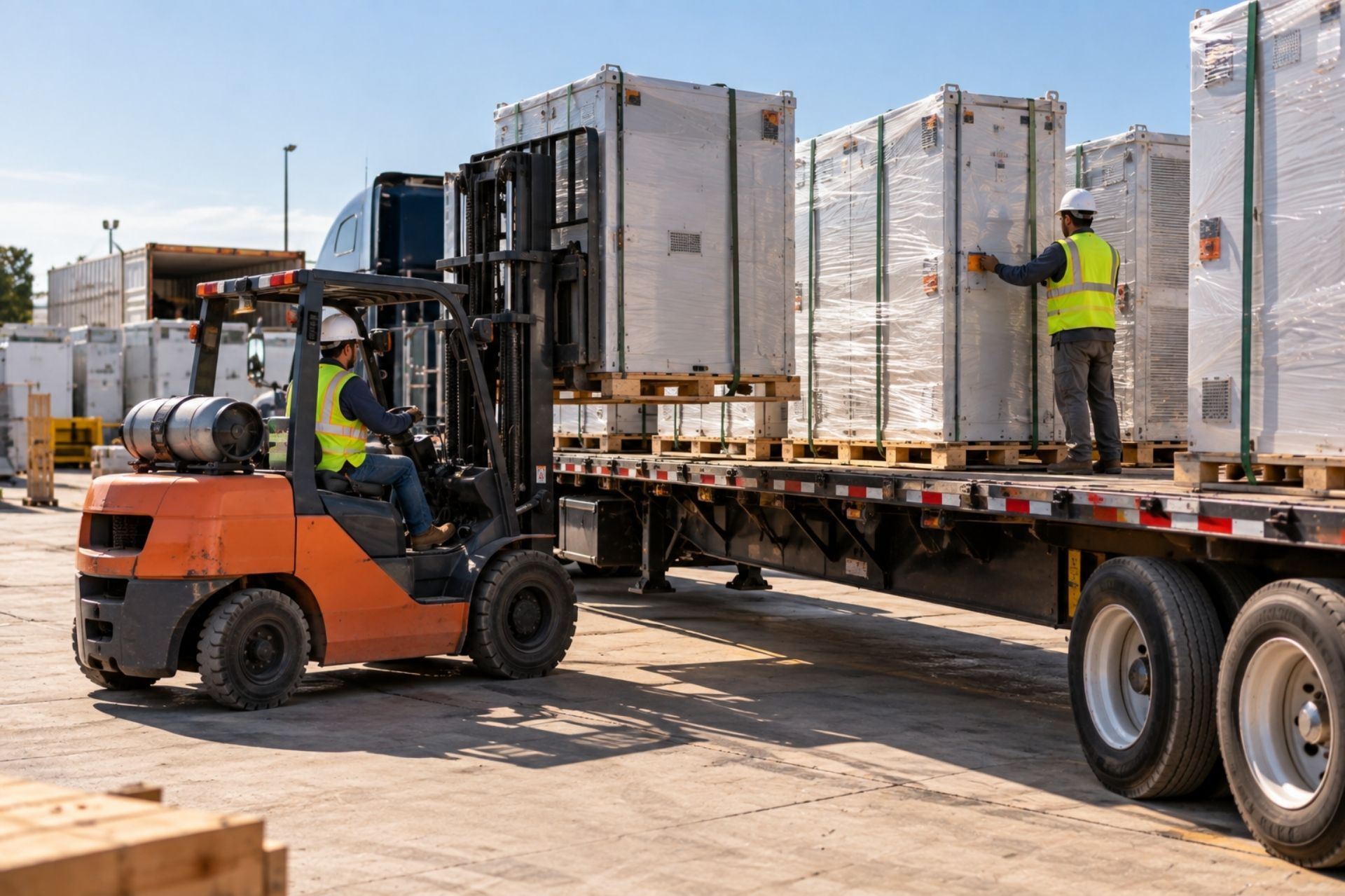
Battery cells, inverters, and transformers often travel thousands of miles from manufacturing facilities in Asia or Europe to project sites in North America. Transit damage is a real and recurring problem. Insurers are increasingly concerned about transformer damage and contractor errors as primary loss drivers, sometimes more than the battery fire risk that dominates headlines.
A cracked transformer bushing discovered at delivery can add four to six months to a project timeline because replacement transformers have lead times stretching well beyond a year in the current market. That single component failure can cascade into millions in DSU exposure.
Grid Interconnection and Permitting Roadblocks
Grid interconnection remains one of the most frustrating bottlenecks for BESS developers. FERC's interconnection queue reforms have attempted to address the backlog, but delays of 12 to 24 months past initial study completion dates are still common. The challenge for DSU coverage is that interconnection delays are typically not caused by physical damage, which means they fall outside standard policy triggers.
Some specialized underwriters will endorse DSU policies to include "denial of access" or "prevention of ingress" extensions, but these are negotiated on a case-by-case basis and come with significant premium increases. Your broker needs to understand the distinction between insurable and uninsurable delay causes.
Technical Failures During Site Testing
Commissioning testing is where many BESS projects encounter unexpected problems. Battery management system (BMS) software glitches, thermal runaway events in individual modules, or inverter synchronization failures can all push back the COD. If the failure results in physical damage, even something as contained as a single rack thermal event, the DSU policy can be triggered.
One common mistake developers make is assuming that any technical issue during commissioning qualifies as a covered event. It doesn't. A software bug that requires a firmware update but causes no physical damage won't trigger DSU. The line between "physical damage" and "defects" is where many claims get contested.
Protecting Against Revenue Loss and Fixed Costs
The financial modeling behind a DSU claim is where the real complexity lives. You're not just proving that a delay occurred: you're proving what you would have earned had the project started on time.
Calculating Lost Arbitrage and Ancillary Service Income
BESS revenue projections rely on forward price curves, historical spread data, and contracted rates for ancillary services. During a claim, insurers will scrutinize these projections carefully. They'll often appoint independent loss adjusters with energy market expertise to validate your revenue model.
A few practical tips for strengthening your position:
- Maintain detailed, pre-loss revenue models with clearly documented assumptions
- Secure binding offtake agreements or capacity market awards before the loss, as speculative revenue is much harder to prove
- Track comparable operating assets in the same market to establish benchmark earnings
- Keep records of all market participation registrations and ISO/RTO enrollment dates
Coverage for Debt Service and Penalties
DSU policies can be structured to cover standing charges: fixed costs that continue regardless of whether the project is operating. These typically include debt service payments, land lease obligations, insurance premiums, and staff costs. Some policies also cover contractual penalties, such as liquidated damages owed to an offtaker for late delivery, though this coverage requires explicit endorsement.
Lenders pay close attention to DSU limits during project finance due diligence. If the DSU indemnity period is shorter than the worst-case delay scenario, the project's debt service coverage ratio can drop below covenant thresholds. This is why DSU isn't optional for financed BESS projects: it's a bankability requirement.
Navigating Time-Based Deductibles and Indemnity Periods
DSU policies use time-based deductibles rather than dollar-amount deductibles. A typical BESS DSU policy might carry a 60-day or 90-day waiting period before coverage kicks in. You absorb the financial impact of the first 60 or 90 days of delay, and the insurer picks up the rest.
The indemnity period, the maximum time the policy will pay, usually ranges from 12 to 24 months for BESS projects. Setting this correctly requires careful analysis. If you choose a 12-month indemnity period but your transformer replacement takes 14 months, you're self-insuring the final two months of delay at your own expense.
One nuance that catches many project sponsors off guard: the waiting period and indemnity period often run concurrently from the date of physical damage, not from the planned COD. This means a loss occurring early in construction could exhaust the indemnity period before the project was ever scheduled to generate revenue. Work with a specialized energy broker who understands these timing mechanics.
Comparison: Standard vs. Comprehensive BESS Delay Coverage
| Feature | Standard DSU | Comprehensive DSU |
|---|---|---|
| Underlying trigger | Physical damage only | Physical damage plus named perils extensions |
| Revenue streams covered | Single contracted revenue source | Arbitrage, ancillary services, capacity payments |
| Waiting period | 90-120 days | 30-60 days (negotiable) |
| Indemnity period | 12 months | 18-24 months |
| Penalty coverage | Excluded | Endorsed for contractual penalties |
| Interconnection delay | Excluded | Optional extension available |
| Premium range | Lower, but significant coverage gaps | Higher, aligned with actual project risk |
The
insurance trends shaping 2026 show that underwriters are increasingly willing to offer broader DSU terms for BESS projects with strong engineering data and experienced EPC contractors. Providing detailed loss control reports, thermal management specifications, and maintenance protocols gives you real negotiating power on both coverage terms and pricing.
Frequently Asked Questions About BESS Startup Insurance
Does DSU cover delays caused by battery cell defects? Only if the defect results in physical damage. A manufacturing defect that causes a thermal event and damages adjacent equipment would likely trigger coverage. A defect discovered during testing that requires replacement but causes no damage typically wouldn't.
Can I buy DSU as a standalone policy? No. DSU attaches to an underlying property or marine cargo policy. It responds only when the underlying policy pays a covered claim that results in a project delay.
How do insurers verify my lost revenue claim? They appoint independent loss adjusters who review your revenue model, market data, offtake agreements, and comparable asset performance. Pre-loss documentation is critical.
What's the typical premium for BESS DSU coverage? Premiums vary widely based on project size, technology, location, and EPC contractor experience. Expect DSU to add 15-30% to your total construction insurance cost, though projects with strong risk engineering data can negotiate better rates.
Does DSU cover force majeure delays? Only if the force majeure event causes physical damage covered under the underlying policy. A hurricane that damages on-site equipment would trigger DSU. A government-ordered construction moratorium without physical damage would not.
Are second-life battery projects eligible for DSU? Coverage is available but more difficult to place. Underwriters view
second-life and repurposed battery systems as higher risk due to uncertain degradation profiles, which affects both the underlying property policy and any attached DSU terms.
Making the Right Choice for Project Bankability
BESS delay in startup insurance isn't a box-checking exercise: it's the financial backstop that keeps your project solvent when commissioning goes sideways. The difference between a well-structured DSU program and an inadequate one can mean the difference between a temporary setback and a project default.
Start by modeling your worst-case delay scenarios honestly. Factor in current lead times for critical equipment like transformers and inverters. Match your indemnity period and waiting period to those scenarios, not to your budget. And work with a broker who specializes in energy storage, someone with access to Lloyd's syndicates and surplus lines carriers who understand BESS-specific risks.
Your engineering data is your strongest negotiating tool. Projects that present detailed thermal management plans, experienced EPC teams, and comprehensive commissioning protocols consistently secure broader coverage at better rates. The investment in pre-placement risk engineering pays for itself many times over when a claim actually hits.
Search by posts
Recent posts